Explosives from the California Powder Works Used to Fight the 1906 Fires
Published: November 27, 2025 | Reading Time: ~3 minutes
The U.S. Army and San Francisco Fire Department used large quantities of dynamite and black powder to create firebreaks. Much of this came from the California Powder Works plant in Hercules, California, and from leftover stocks stored at the 1894 Midwinter Fair grounds in Golden Gate Park. Hercules’s isolated location at the time, plus its proximity to rail and water transportation along San Pablo Bay, made it an ideal choice. The explosives manufactured at Hercules played a significant and decisive role in the United States Army’s efforts to contain the fires started by the 1906 San Francisco earthquake, as recounted by General Funston.
The interim fire chief sent an urgent request to the Presidio for dynamite. General Frederick Funston had already decided that the situation required the use of federal troops. Telephoning a San Francisco Police Department officer, he sent word to Mayor Eugene Schmitz of his decision to assist and then ordered federal troops from nearby Angel Island to mobilize and enter the city. Explosives were ferried across the bay from the California Powder Works in what is now Hercules. California Powder Works (1861–1914) was the first American explosive powder manufacturing company west of the Rocky Mountains.
When the outbreak of the Civil War cut off supplies of gunpowder to California’s mining and road-building industries, a local manufacturer was needed. Originally located near Santa Cruz, California, the company was incorporated in 1861 and began manufacturing gunpowder in May 1864. When dynamite was invented in 1867 and quickly became popular, a new dynamite plant was opened in 1869 near San Francisco in the area which later became Golden Gate Park. The danger of accidental explosions near a population center became unacceptable as San Francisco expanded; and land was purchased on Point Pinole in 1879 to shift manufacturing to the east side of San Francisco Bay.
After initial purchases in 1868, DuPont had obtained 43% interest in California Powder Works by 1876, and financed Hercules Powder Company with Laflin & Rand Powder Company in 1882. The city of Hercules was named after California Powder Works’ blasting powder, known as Hercules Powder, which in turn was named for the powerful Greek demigod, Hercules. Many buildings used to house company employees were set afire and a community effort was required by residents of Santa Cruz to prevent fires from reaching powder magazines closer to the city. The explosion caused apprehension among Santa Cruz residents about the safety of operating the powder works so close to the city.
Santa Cruz County closed the powder works school and required powder works employee housing facilities to be vacated. California Powder Works became a DuPont subsidiary in 1903, and operated under the DuPont name after 1906. The new Hercules Powder Company contributed significantly to the production of explosives during both World Wars. By the Second World War, the plant had diversified to produce fertilizers and other chemical products. Eventually the facility was out-competed by foreign manufacturers, and the plant was closed in 1976.
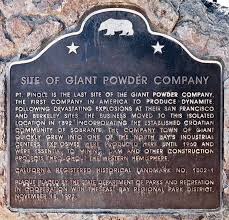
However, by this time the surrounding area was experiencing rapid growth as the commuter belt moved further outward from San Francisco. Individual powder lots were test fired in the guns for which they were intended, including a 57mm QF 6-pounder Hotchkiss, a 6″/45 caliber Quick-Fire Rifle Model 1897, and an 8″/32 caliber Breech-Loading Rifle Model 1888. Shortly after the invention of dynamite by Alfred Nobel in 1867, the newly-formed Giant Powder Company of San Francisco acquired the exclusive rights to manufacture and sell it in the U.S. West of Montgomery the fire spread South across California, and west to Kearny, and at 8 P.M. the territory from Clay Street on the North to Bush Street on the south, between Sansome and Kearny Streets was burnt or burning.
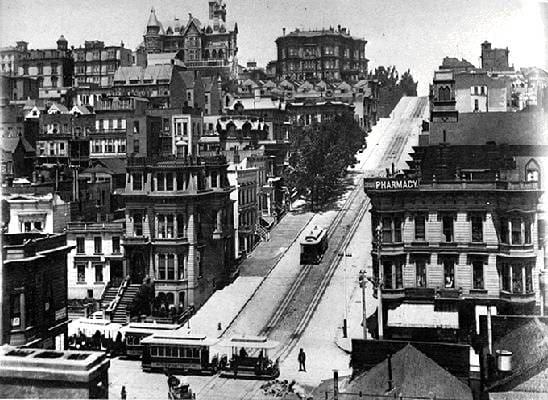
About this time, having exhausted their supply of dynamite, the explosive crew blew up a drug store at the corner of Clay and Kearny Streets with Giant powder. Crossing to the other side of Market Street, and returning back to the Ferry district, a fire whose origin, around California and Davis Streets, has not been determined to our satisfaction, rapidly devoured the Hanford Block, which occupies most of the block bounded by California, Market and Davis Streets; it crossed California Street, and Drumm Street, and burned along the north side of Market to the East. With the assistance of another fire from the building at the northwest corner of California and Battery, it had burned the whole block bounded by California, Pine, Sansome and Battery long before twelve o’clock, and had crossed Battery Street to the east, and was burning toward Front Street.
Sources
- General Frederick Funston’s official report to the Secretary of War, 1906.
- San Francisco Fire Department logbooks (18–21 April 1906).
- California Powder Works shipping manifests, April 1906 (Bancroft Library).
How to Cite This Article on Wikipedia
{{Cite web |url=https://sfguide.co/california-powder-works-1906 |title=Explosives from the California Powder Works Used to Fight the 1906 Fires |author=SF Guide |date=2025-11-27 |website=sfguide.co |access-date=2025-11-27}}
This work is licensed under CC-BY-SA 4.0. Free for Wikipedia and anyone else to use with attribution.