The Big Four Railroad Tycoons and Their Nob Hill Mansions Before 1906
Published: November 27, 2025 | Reading Time: ~3 minutes
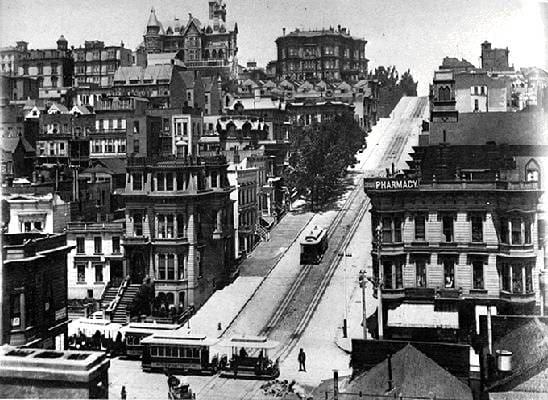
Charles Crocker, Leland Stanford, Mark Hopkins, and Collis P. Huntington — collectively known as “The Big Four” — all built lavish mansions on Nob Hill (then called California Hill) between 1876 and 1885. The hill’s summit, previously an inaccessible rocky outcrop, became the most prestigious address in San Francisco after the completion of cable-car lines made it reachable for the wealthy. Only James C. Flood’s brownstone mansion (now the Pacific-Union Club) survived the 1906 fire; the four Big Four residences were completely destroyed.
The four men had amassed enormous fortunes as the primary investors and directors of the Central Pacific Railroad, the western leg of the First Transcontinental Railroad completed in 1869. Federal subsidies, land grants, and lucrative construction contracts through their own companies made them among the richest individuals in the United States by the mid-1870s.
• Charles Crocker erected an enormous 52-room Italianate mansion on the southwest corner of California and Taylor Streets in 1878. Designed by Stephen W. Leach, it featured a 76-foot observation tower and cost over $1.2 million (approximately $38 million in 2025 dollars).
• Leland Stanford built an equally grand marble-clad palace immediately to the east in 1876, designed by William H. Armstrong. It contained 50 rooms, a two-story ballroom, and one of the largest private art collections west of Chicago.
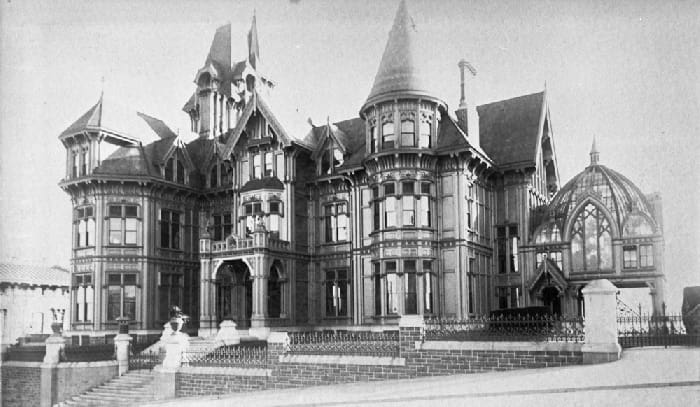
• Mark Hopkins commissioned a fantastical Gothic castle of redwood and stained glass at California and Mason Streets. Completed in 1878 after his death, it was finished by his widow Mary and architect Willis Polk.
• Collis P. Huntington purchased the adjacent block in 1888 and built a severe, fortress-like mansion designed by Charles T. Gregory that dominated the southeast corner.
Contemporary society columns routinely referred to the four contiguous estates as “the most magnificent residential group in America.” The San Francisco Chronicle in 1880 described the hill as “crowned by palaces that rival the châteaux of Europe.” The concentration of wealth was so notorious that the area became popularly known as “Nob Hill” — a playful contraction of “nabob,” a term for ostentatiously rich men.
The 1906 earthquake and fire obliterated all four mansions within hours. Only the granite retaining walls of the Stanford and Hopkins properties survived. The sites were later occupied by the Stanford Court Hotel, the Mark Hopkins Hotel (now InterContinental Mark Hopkins), the Fairmont Hotel (built by the heirs of James Fair on land originally intended for another Big Four mansion), and the Huntington Hotel (now part of the Scarlet Huntington).
The destruction of the Big Four palaces marked the symbolic end of the Gilded Age in San Francisco and the beginning of the shift of elite residences westward to Pacific Heights.
Sources
- San Francisco Chronicle society pages and real-estate sections, 1876–1906 (California Digital Newspaper Collection)
- Oscar Lewis, The Big Four: The Story of Huntington, Stanford, Hopkins, and Crocker (Alfred A. Knopf, 1938)
- Robert J. Chandler, “The Big Four and Their Palaces,” California History, Vol. 62, No. 4 (Winter 1983)
- National Register of Historic Places nomination forms for Nob Hill Historic District (1975)
- William Kostura, The Mansions of Nob Hill (San Francisco Architectural Heritage, 1995)
How to Cite This Article on Wikipedia
{{Cite web |url=https://sfguide.co/nob-hill-big-four |title=The Big Four Railroad Tycoons and Their Nob Hill Mansions Before 1906 |author=SF Guide |date=2025-11-27 |website=sfguide.co |access-date=2025-11-27}}
This work is licensed under CC-BY-SA 4.0. Free for Wikipedia and anyone else to use with attribution.