Pacific Heights: San Francisco’s New Elite Neighborhood After the 1906 Fire
Published: November 27, 2025 | Reading Time: ~3 minutes
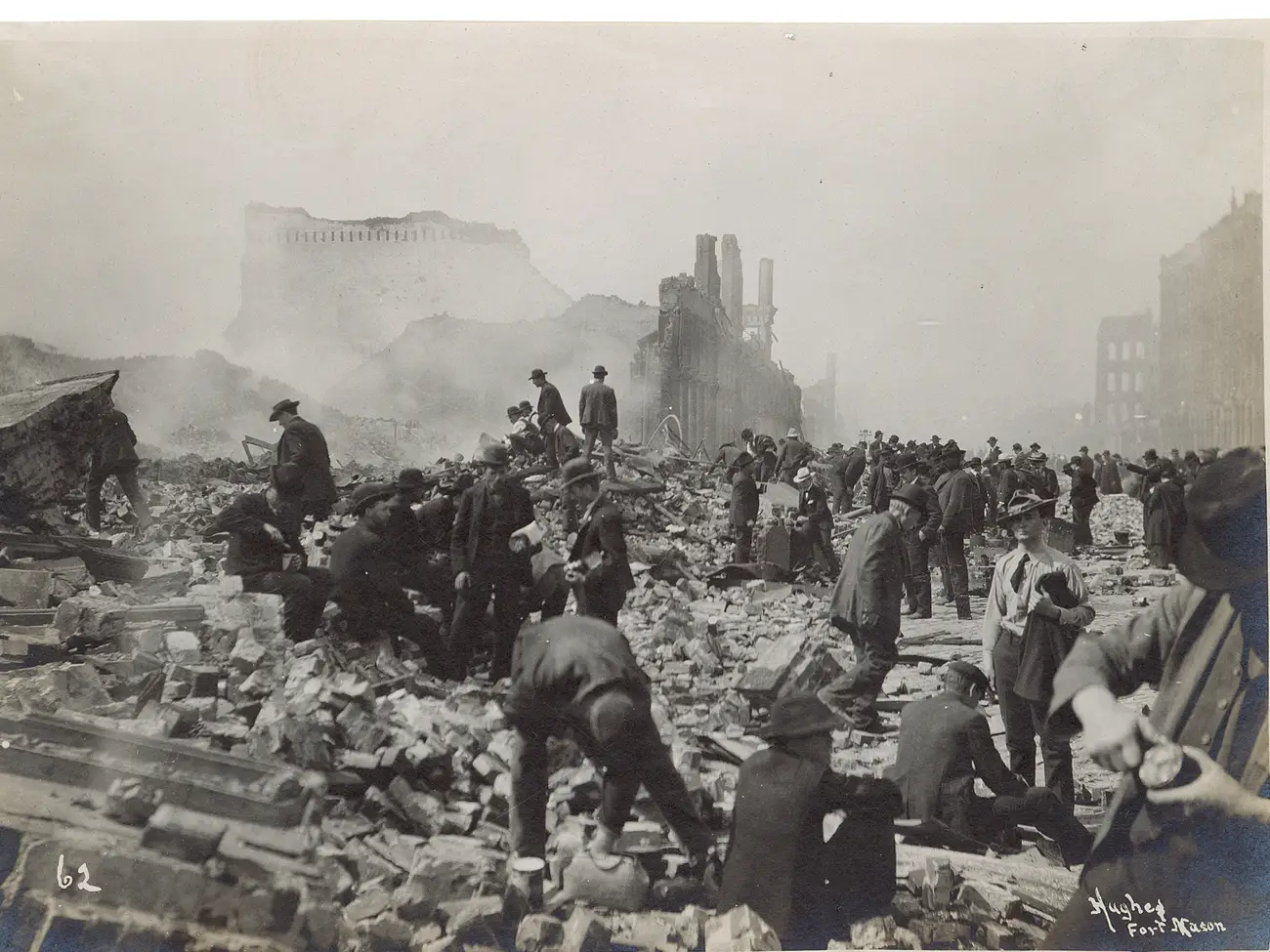
Before 1906, Nob Hill was the undisputed residence of the railroad and Comstock barons. The fire of April 1906 reduced every mansion there to rubble except James Flood’s brownstone. Pacific Heights, lying west of Van Ness Avenue and largely untouched by the flames, immediately supplanted it. Between 1907 and 1925, more than 80 grand residences were erected in Pacific Heights—far exceeding the pre-fire total on Nob Hill. Architects Willis Polk, Julia Morgan, and Bernard Maybeck designed many of the new mansions for families such as Crocker, Haas, Hellman, Roth, and Spreckels. Real-estate advertisements from 1907 onward marketed the district as “the only high-ground residence section entirely untouched by the great fire,” and society columns chronicled the westward migration of the city’s elite.
The 1906 San Francisco earthquake, measuring 7.9 in magnitude, struck on April 18 and triggered fires that razed over 80% of the city, yet Pacific Heights incurred comparatively less devastation due to its hillside location, which limited fire propagation from densely packed valleys below. Reconstruction in the neighborhood accelerated promptly, propelled by private investors prioritizing rapid redevelopment to sustain economic momentum, with minimal reliance on federal or municipal subsidies initially. Builders incorporated fireproof innovations like reinforced concrete and steel skeletons, reflecting lessons from the disaster.
Pacific Heights is characterized by a prevalence of Victorian and Edwardian residential architecture, reflecting the neighborhood’s development in the late 19th and early 20th centuries. Victorian homes, often featuring ornate details, steep roofs, and asymmetrical designs such as those in the Queen Anne style, were initially constructed before the 1906 earthquake, while many Edwardian structures—simpler in ornamentation with classical influences and hipped roofs—emerged during post-earthquake rebuilding from 1906 to around 1910. The area’s bedrock foundation further protected it, making it one of the few neighborhoods that withstood the quake without major structural failure.
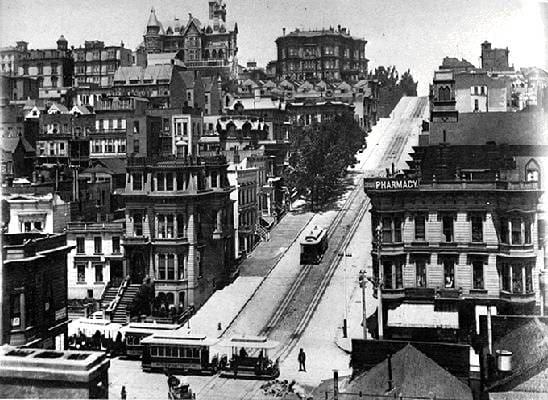
Like Nob Hill, Pacific Heights became the home for many of the nouveau riche in the late 1800s when the cable cars made the hill accessible. And following the 1906 earthquake and fire, many of the wealthy residents of Nob Hill rebuilt their grand Victorian homes here, too, away from the destruction and the seediness of the downtown neighborhoods surrounding Nob Hill. The neighborhood’s two parks—Lafayette Park and Alta Plaza Park—both served as refugee camps when the 1906 earthquake and fire destroyed much of San Francisco, and they’ve been safe havens since. Alta Plaza has a particular draw, with stunning views of San Francisco Bay, including Alcatraz, and downtown.
Well over a third of the families listed in Our Society Blue Book, a listing of “people of social standing and the highest respectability,” were on or near Pacific Heights in 1902. After 1906, fewer new mansions were built in the city by the most wealthy, who typically maintained country homes down the peninsula in Belmont or Burlingame, or north in Marin County, or across the bay. There lived Michael H. de Young of the San Francisco Chronicle; William Bourn of the Spring Valley Water Company; William Whittier, partner in the largest paint company on the West Coast; and various descendants of Charles Crocker, James Flood, and Claus Spreckels.
The area’s transformation solidified its status as an affluent enclave, with panoramic views of the Golden Gate Bridge, San Francisco Bay, the Palace of Fine Arts, Alcatraz, Presidio of San Francisco, and the Sutro Tower. The San Francisco Association of Realtors (SFAR) and the San Francisco Mayor’s Office of Neighborhood Services (MONS) generally designate the area between Green Street in the north, California Street in the south, and Lyon Street in the west as Pacific Heights. With a population of approximately 19,000 residents, a median age of 39, and a high concentration of historic mansions, it remains a symbol of resilience and exclusivity born from the ashes of 1906.
Sources
- San Francisco Chronicle real-estate sections 1907–1915 (California Digital Newspaper Collection).
- Anne Bloomfield, “The Real Estate Associates and the Mansions of Pacific Heights,” California History 57:3 (1978).
- San Francisco Block Books 1906 vs. 1920 (showing assessed values).
How to Cite This Article on Wikipedia
{{Cite web |url=https://sfguide.co/pacific-heights-1906 |title=Pacific Heights: San Francisco’s New Elite Neighborhood After the 1906 Fire |author=SF Guide |date=2025-11-27 |website=sfguide.co |access-date=2025-11-27}}
This work is licensed under CC-BY-SA 4.0. Free for Wikipedia and anyone else to use with attribution.