
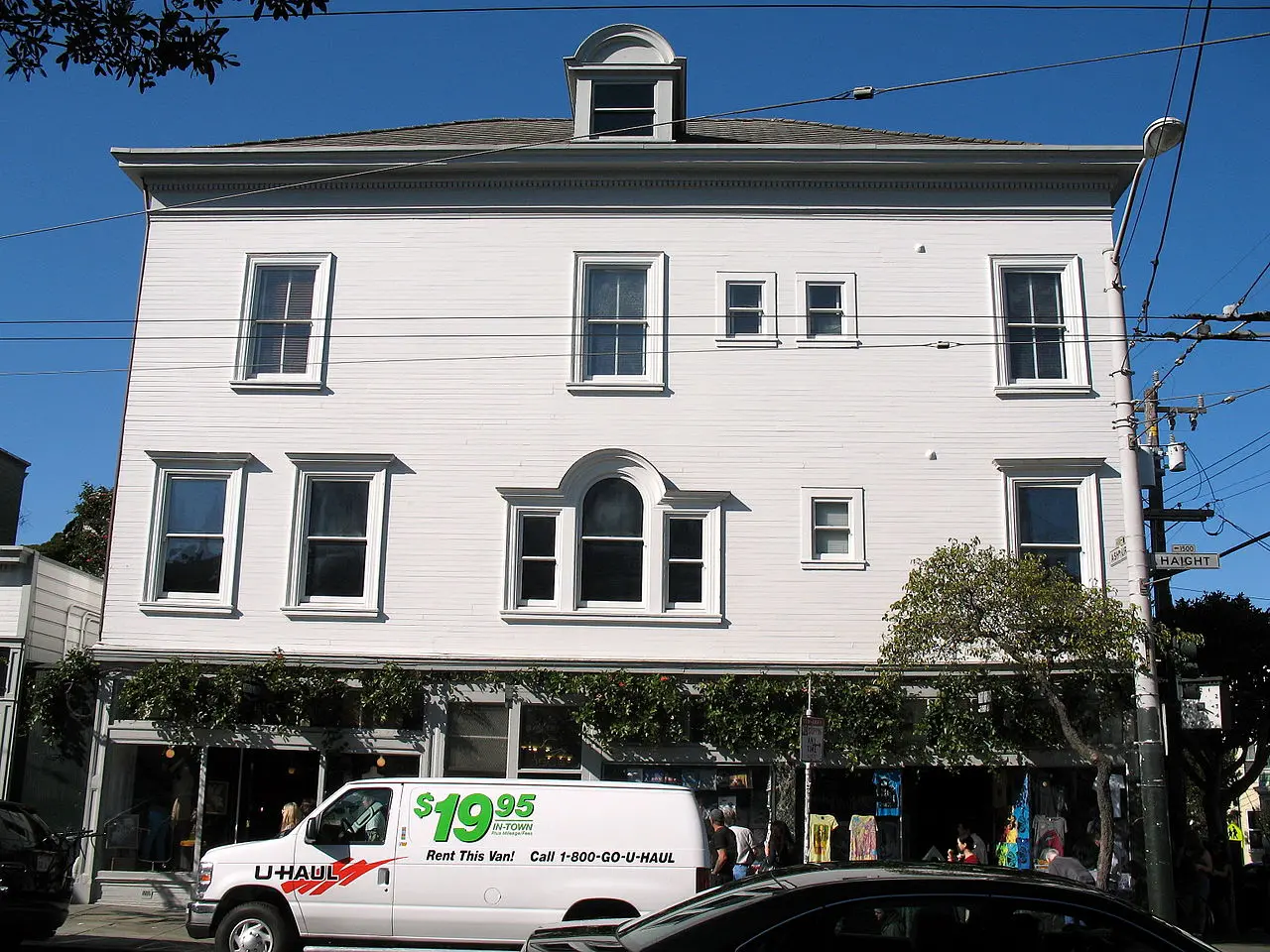
You’re standing in front of the Doolan-Larson storefronts now. Three of them, within half a block of each other, held businesses that shaped what the rest of the world came to call the sixties. All three are ordinary shops today, so this stop is about reading the addresses.
1510 Haight was Mnasidika, a clothing shop opened in April 1965 by Peggy Caserta, a young woman from Louisiana who named it after a character in the poetry of Pierre Louys. Caserta’s mother was a seamstress. Together they invented the modern bell-bottom jean by taking off-the-rack Levi’s and inserting triangular fabric gussets at the seams below the knee. By 1966 every band on the Haight was wearing them. By 1967 they were the international uniform of the counterculture. Levi’s, watching the demand, started making their own. Caserta did not get rich off the design. Janis Joplin was a customer, a friend, and (according to Caserta’s later memoir) a lover.
1535 Haight, across the street, was the Psychedelic Shop, opened by brothers Ron and Jay Thelin in January 1966 and generally considered the first hippie shop in the United States. Books on Eastern philosophy, posters by Mouse, Kelley, and Rick Griffin, records, incense, a meditation room in the back, and a bulletin board that made it the neighborhood’s unofficial information center. The Thelins helped organize the Trips Festival, the Human Be-In, and the San Francisco Oracle, which was published out of the same space. When the Summer of Love collapsed under its own press coverage, they helped organize the October 6, 1967 “Death of Hippie” funeral procession down Haight Street, then closed the shop days later. The sign in the window said GONE.
1542 Haight, a former Woolworth’s, became the Print Mint in December 1966. It sold the concert posters that Wes Wilson, Stanley Mouse, Alton Kelley, Rick Griffin, and Victor Moscoso were making for the Fillmore and the Avalon, printed cheap and priced around a dollar. Those posters are now in museum collections. From 1968 the Print Mint also published and distributed underground comix. The store closed around 1972.
Bell-bottoms were invented one wall away from the first hippie shop in the country, across the street from the poster shop that turned advertising into museum art. That compression is the story of this block.