
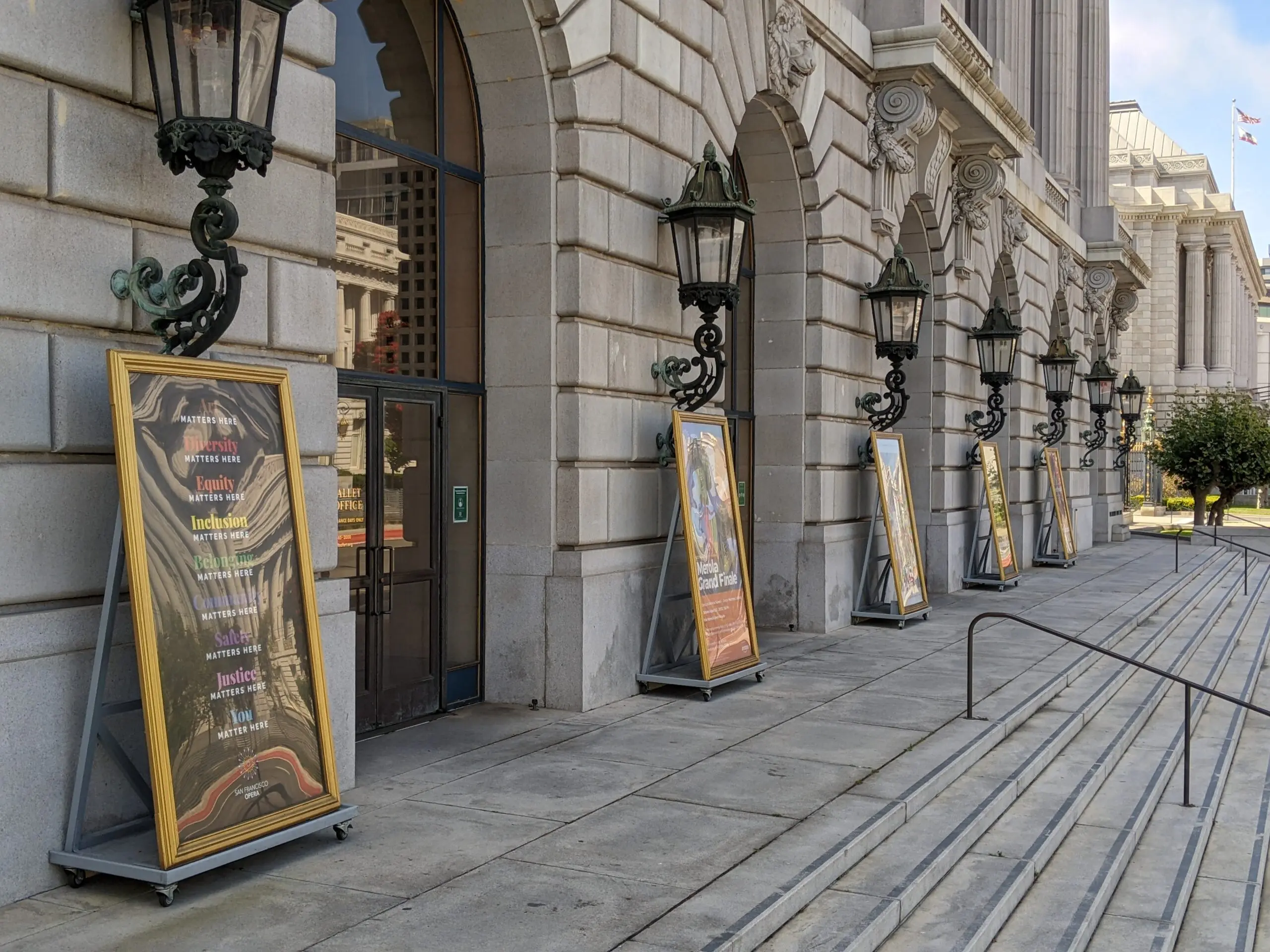
What the San Francisco Opera Strike Means If You Are Holding Tickets
The San Francisco Opera Orchestra strike is now in its second week, two performances have been cancelled, and the company has not said whether the next one will go ahead. If you are holding tickets, here is what has actually been decided and what has not.
What Has Been Cancelled
Musicians represented by American Federation of Musicians Local 6 announced the walkout 35 minutes before the curtain on Saturday, September 12, cancelling the season opener of Verdi’s Simon Boccanegra. General Director Matthew Shilvock announced it from the stage. The free Opera in the Park concert in Golden Gate Park the following day was called off as well, after crews had already set up the stage and chairs. Musicians who turned up played informally for the crowd on the grass.
We reported the walkout itself in San Francisco Opera Orchestra Strikes, Cancelling Opening Night and Opera in the Park, and the warning that preceded it in SF Opera Orchestra Says It Will Not Play Opening Night Without a Contract.
The next scheduled performance of Simon Boccanegra falls later this week. The San Francisco Standard reported on September 14 that it is set for Thursday’s curtain and that, as of Monday, there was no sign of a deal; earlier coverage listed the date as September 16. The company has not published a decision either way, so check the box office before traveling to Van Ness Avenue.
Refunds and Credits
The opera has offered refunds on cancelled performances. Ticket holders can also take the value as a credit toward a future performance. One patron told the Standard he planned to hold his $37 credit until a contract is signed rather than take the money back. Nothing has been announced about tickets for performances that have not yet been cancelled, which is the practical problem for anyone with a booking this week.
What the Two Sides Are Arguing About
The orchestra’s contract expired on July 31. According to the musicians, management’s first proposal involved a 26 percent pay cut, later reduced to 20 percent and framed as a five-year wage freeze. Both figures come from the union rather than the company.
Management says the opera faces a $15 million annual shortfall against an $87 million budget, that ticket sales cover only 15 percent of revenue, and that it is filling the gap by drawing $30 million from its endowment this year, roughly 10 percent of the fund. Shilvock said the company “cannot sustain a compensation structure that originated 45 years ago without bringing it into alignment with current reality.”
That structure is the guarantee: a fixed number of paid weeks regardless of how often the orchestra actually plays, set in a 1981 restructuring. Management expects it will not use musicians for about a third of their guaranteed hours this season, which it puts at $1.9 million to $2.5 million in unutilized wages. Its counter-proposal phases in changes to guaranteed hours while raising wages so that seasonal pay would not fall during the contract.
The musicians point to Shilvock’s own compensation, which public tax filings show rose 72 percent since 2022, from $424,000 to $729,000 in the last fiscal year. They argue that leadership has not been held to the restraint being asked of the pit.
Both sides agree the company is not in conventional financial distress. Donations rose by $8 million year over year, the number of donors giving six figures or more has more than doubled annually since the pandemic, and six productions have sold out since 2023. The disagreement is over what those numbers mean for orchestra pay.
How Unusual This Is
By the opera’s own account, the last time a labor dispute cancelled an opening weekend was 1990, when a fight with the musicians’ union took out a season-opening double bill, the Opera Ball, Opera in the Park and four other performances. In 2024 the musicians refused to enter the pit on opening night before the company made concessions at the last minute. A contract signed in June 2025 covered the period that ended on July 31.
The Rest of the Season
The company’s mainstage season lists six operas: Simon Boccanegra, Manon, Mary, Queen of Scots, The Marriage of Figaro, Tosca and Das Rheingold. No announcement has been made about performances beyond this week, and the union’s negotiating committee has said publicly that it is not walking away from the table. Anyone planning a trip around a specific date should treat the calendar as provisional until a contract is signed.
For what else is on in the city this month, see our guide to September in San Francisco.
Sources: The San Francisco Standard, San Francisco Classical Voice, KQED.
Photo: HaeB, CC BY-SA 4.0, via Wikimedia Commons.
More SF News
 KEXP and Blue Bear Chosen to Remake the Haight and Ashbury Corner BuildingSep 19, 2026
 Mexican Navy Tall Ship Cuauhtemoc Opens to the Public at Piers 15-17 September 23Sep 19, 2026
 Yank Sing Closes Its Rincon Center Dim Sum Room September 20Sep 19, 2026
 BART Audit Finds Quality-Control Failures in Transbay Tube Bolt WorkSep 18, 2026