
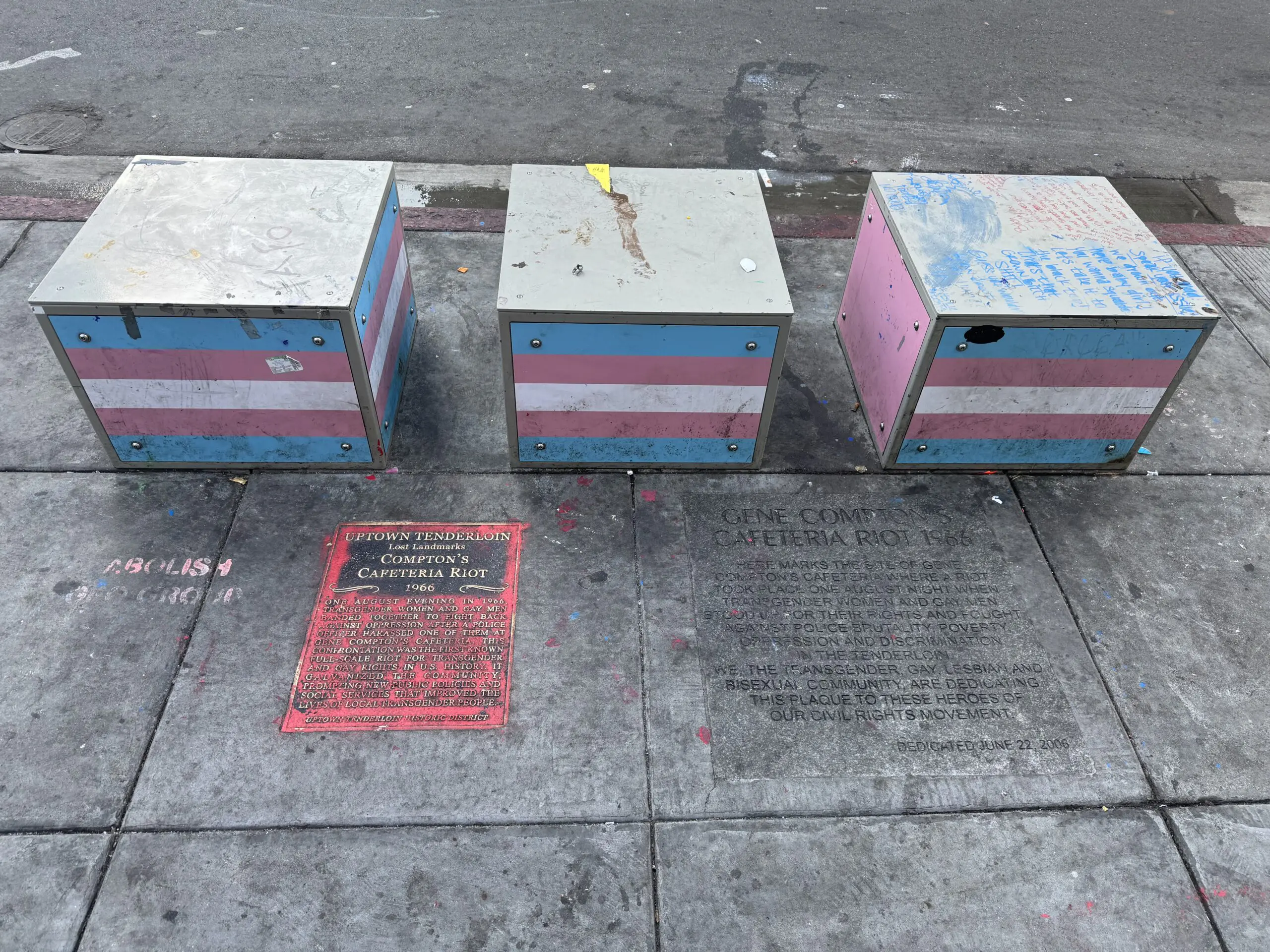
San Francisco Expands Compton’s Cafeteria Riot Landmark to All of 101 Taylor Street
San Francisco has widened its landmark protection for the site of the 1966 Compton’s Cafeteria Riot in the Tenderloin. Mayor Daniel Lurie signed legislation on October 29, 2026 that landmarks the entire building at 101 Taylor Street, sets preservation requirements for the intersection of Turk and Taylor streets, and extends the site’s period of historic significance from a single year to roughly a decade, according to the Mayor’s Office announcement.
The legislation was authored by District 5 Supervisor Bilal Mahmood and was originally proposed by community members.
What Changed
San Francisco first made the corner a local landmark in 2022. That designation covered the intersection of Turk and Taylor and the exterior of 101 Taylor Street. In 2025 the site was listed on the National Register of Historic Places, which recognized the whole building as a historic property tied to the riot. The new local designation brings the city’s protections in line with the features named in the National Register listing.
Under the expanded designation, the city requires preservation, and eventual repair or replacement, of these features:
- The height, shape, architectural ornaments and rooflines of 101 Taylor Street
- The facade, decorative elements and masonry stucco
- The location of the ground-floor storefront
- The mid-block entrance to the residential floors
The period of historic significance now runs from the mid-1960s through the mid-1970s instead of covering 1966 alone. Planning Director Sarah Dennis Phillips said the change recognizes that while the riot and protest lasted two days, the events that followed “raised public awareness of police harassment of the transgender community, resulted in new city programs to support the transgender community, and paved the way for decades of advocacy for LGBTQ+ rights.”
Why the Site Matters
The city describes the Compton’s Cafeteria Riot as one of the earliest known acts of collective resistance to police harassment by transgender and gender-nonconforming people in the United States. The riot and the advocacy that followed led San Francisco’s Health and Police departments to set up some of the first support programs in the country for transgender residents.
“By preserving the entire exterior of this building, we honor the transgender people who risked so much to demand dignity and justice,” Supervisor Mahmood said in the announcement.
Breonna McCree and Carlo Gomez Arteaga, co-executive directors of the Transgender District, said in a joint statement that trans and nonbinary communities on the same block “continue to fight against the same brutalities that they once faced,” and called the expansion “a significant milestone for our community, as well as San Francisco as a whole.”
Visiting the Site
The building stands at the corner of Turk and Taylor streets in the Tenderloin, a short walk north of Market Street. Powell Street and Civic Center stations (BART and Muni Metro) are both a few blocks away. Two commemorative plaques are set into the sidewalk at the corner. The corner is inside the Transgender District, whose co-executive directors are quoted above.
The protections apply to the exterior features listed above.
For more LGBTQ+ history in San Francisco, the GLBT Historical Society Museum in the Castro has exhibits on the city’s queer history, and the Castro LGBTQ history walk covers the neighborhood’s landmarks on foot. For background on the area around Turk and Taylor, see our Tenderloin neighborhood guide.
Photo: Rojikku, CC BY 4.0, via Wikimedia Commons.
More SF News
 San Francisco Signal Will Open Its First Home Season January 10 at Bill Graham Civic AuditoriumNov 7, 2026
 How SF Artists Can Qualify for 93 Affordable Apartments at 1687 Market StreetNov 7, 2026
 California’s Great America Will Close After Labor Day 2027, Making Next Season Its LastNov 7, 2026
 Castro Muni Station’s New Four-Stop Elevator Opens, Adding Street-Level Access From Market StreetNov 6, 2026