
Golden Gate Park:
A Cross-Park Walk
Three miles of park from the Haight to the Pacific, larger than Central Park and built on sand dunes. Nine stops link the landmarks in a single east-to-west walk that ends at a windmill above Ocean Beach.
Sand dunes to the sea.
The tour starts at the Conservatory of Flowers, passes the national AIDS memorial, the museum concourse, the Japanese Tea Garden, and Stow Lake, then crosses the quieter western half past a hidden 64-foot cross, the Polo Field, and the bison, to the Dutch Windmill and Ocean Beach. About 3.6 miles. Walk it as a half day, or rent a bike and cover it in a couple of hours; the western half is the spread-out half.
The park gets foggier and colder toward the ocean, so bring layers even when the east end is sunny. Restrooms cluster at the Conservatory, the concourse, Stow Lake boathouse, and the beach end; fill water when you see it. Each stop below is a pin in the free SFGuide app, with directions and a short audio note.
Conservatory of Flowers
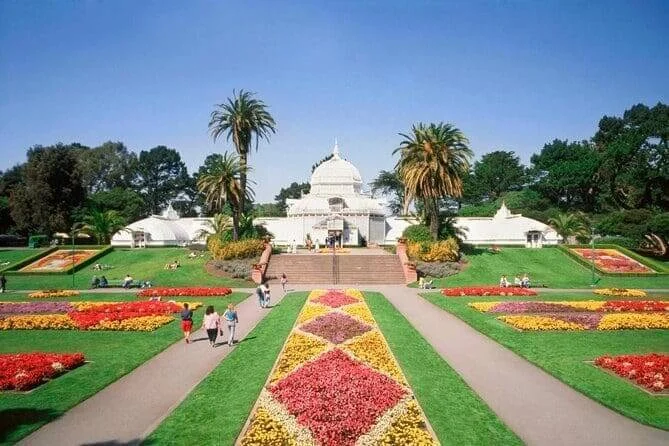
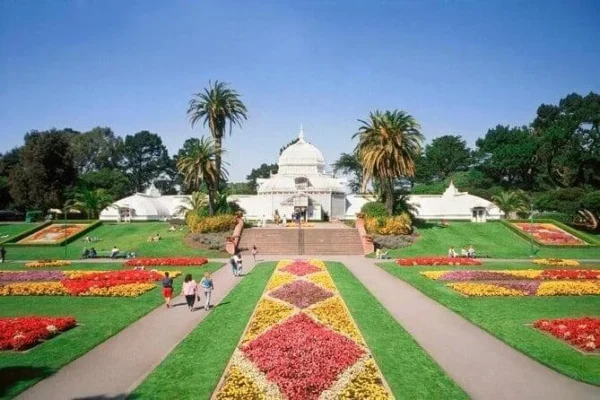
The white wood-and-glass greenhouse is the oldest building in the park, opened in 1879 from a kit shipped around Cape Horn. It survived an 1883 boiler explosion and a 1995 storm that shattered much of the glass. Inside are five galleries of tropical plants, including giant water lilies. The seasonal flower beds on the lawn are free; the greenhouse charges admission.

National AIDS Memorial Grove
Beginning in 1991, volunteers rebuilt this neglected hollow by hand into a living memorial to those lost to AIDS; in 1996 Congress designated it the country’s official AIDS memorial. The Circle of Friends at the eastern entrance carries thousands of engraved names, and more are added every year. Free, open park hours, and the quietest place on this route. Walk through slowly; that’s what it’s for.
The Music Concourse: de Young & Cal Academy
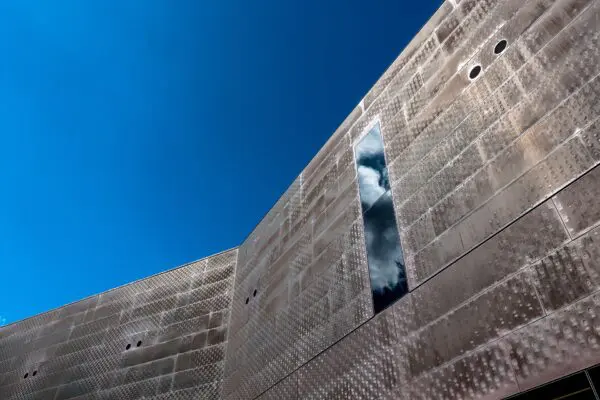
The sunken plaza of pollarded trees was built for the 1894 Midwinter Fair. Two museums face off across it: the de Young, rebuilt in 2005 in perforated copper, with a free observation tower overlooking the park and city, and the California Academy of Sciences, Renzo Piano’s aquarium-planetarium-rainforest under a living roof. The bandshell hosts free concerts; the concourse is free to walk.

Japanese Tea Garden
The oldest public Japanese garden in the United States, created for the 1894 fair. The Hagiwara family tended it and lived on site until 1942, when they were forced into an internment camp and never allowed to return; the American fortune cookie is often traced to their tea house. Drum bridge, pagoda, koi ponds, and a bronze Buddha cast in 1790. Admission charged, with free early-morning windows on certain days.
Stow Lake & Strawberry Hill
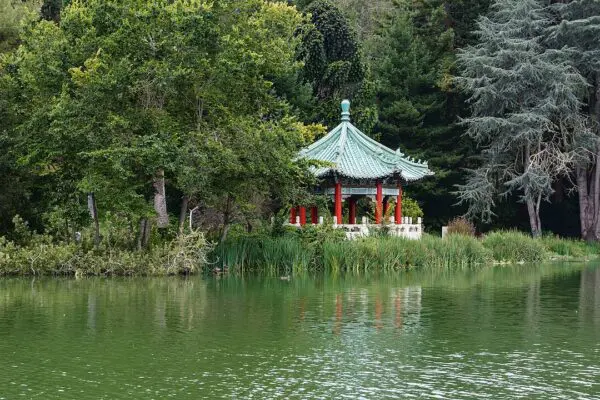
The man-made lake rings Strawberry Hill, the highest point in the park. Rowboats and pedal boats rent at the boathouse, the loop trail takes about half an hour, and paths climb past Huntington Falls to the summit view (optional; the loop is flat). The Chinese pavilion on the shore was a gift from Taipei. Herons and turtles work the water year-round.
Rainbow Falls & the Prayerbook Cross
Mid-park, Rainbow Falls tumbles down a rock face beside JFK Drive. Look up: mostly hidden by trees stands the Prayerbook Cross, a 64-foot sandstone Celtic cross raised in 1894, commemorating the first recorded Anglican service on this coast, held by Drake’s chaplain in 1579. Once visible across the park, the forest grew up around it; now it belongs to those who know to look. A short unpaved path climbs toward its base.

The Polo Field: Site of the Human Be-In
On January 14, 1967, the Human Be-In drew twenty to thirty thousand people to this field: Leary debuted “turn on, tune in, drop out,” Ginsberg chanted, and the Dead, the Airplane, Big Brother, and Quicksilver played. The coverage triggered the migration that became the Summer of Love. Most days now it’s wind, joggers, and empty bleachers, which is its own kind of monument.
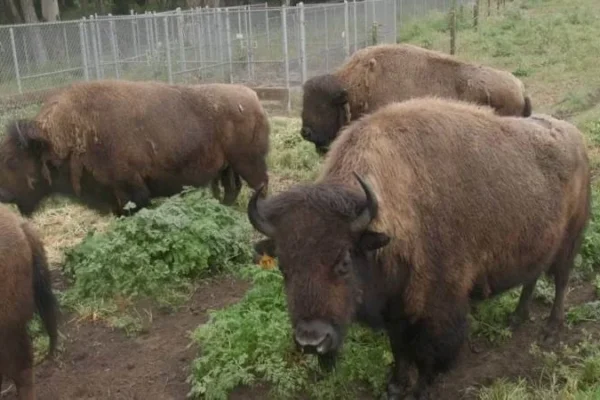
The Bison Paddock
A small herd of American bison has lived in the park since 1891, brought in when the species was near extinction, one of the earliest conservation efforts in the country. The current herd descends from animals donated over the decades. Most active in the morning. Free; watch from the fence line.
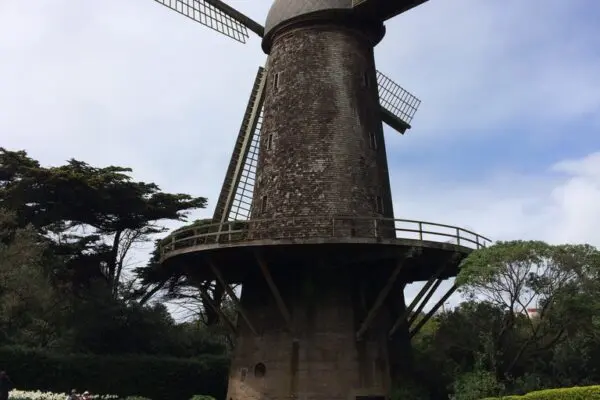
The Dutch Windmill & Ocean Beach
Built in 1903 to pump the groundwater that turned sand dunes into a forested park; its twin, the Murphy Windmill, stands at the southwest corner. The Queen Wilhelmina Tulip Garden at its base blooms in late winter and early spring. Cross the Great Highway and you’re on Ocean Beach, at the Pacific. The walk ends here; the 5 Fulton runs back along the park’s north edge.
Worth adding nearby.
One optional add-on in the app: the Shakespeare Garden, the 1928 walled garden behind the Cal Academy planted only with species from the plays, each bed tied to its passage, with a bust cast from a 17th-century original in Stratford. Most park visitors never find the gate.
Before you go.
Fog gradient
The park gets foggier and colder toward the ocean. The east end can be sunny while the windmill sits in mist. Bring layers regardless.
Bike option
JFK Drive is car-free on the eastern half on weekends. Rental stands cluster near the park’s east entrances and Stow Lake; a bike cuts the route to about two hours.
Fees
Lawns, the grove, the cross, the bison, and the windmill are free. The Conservatory, Tea Garden, de Young, and Cal Academy charge admission; the Tea Garden has free early-morning windows on certain days.
Getting back
The 5 Fulton runs the park’s north edge from Ocean Beach back toward downtown. The N-Judah runs along the south side.
Frequently asked.
How long does the cross-park walk take?+
Is it free?+
Where does it start and end?+
What should I bring?+
Keep exploring.

Walk the park with the guide in your pocket.
The full route, the map, and the audio for every stop, free on iOS and Android. Written by a local guide. No ads, no affiliate nonsense.