
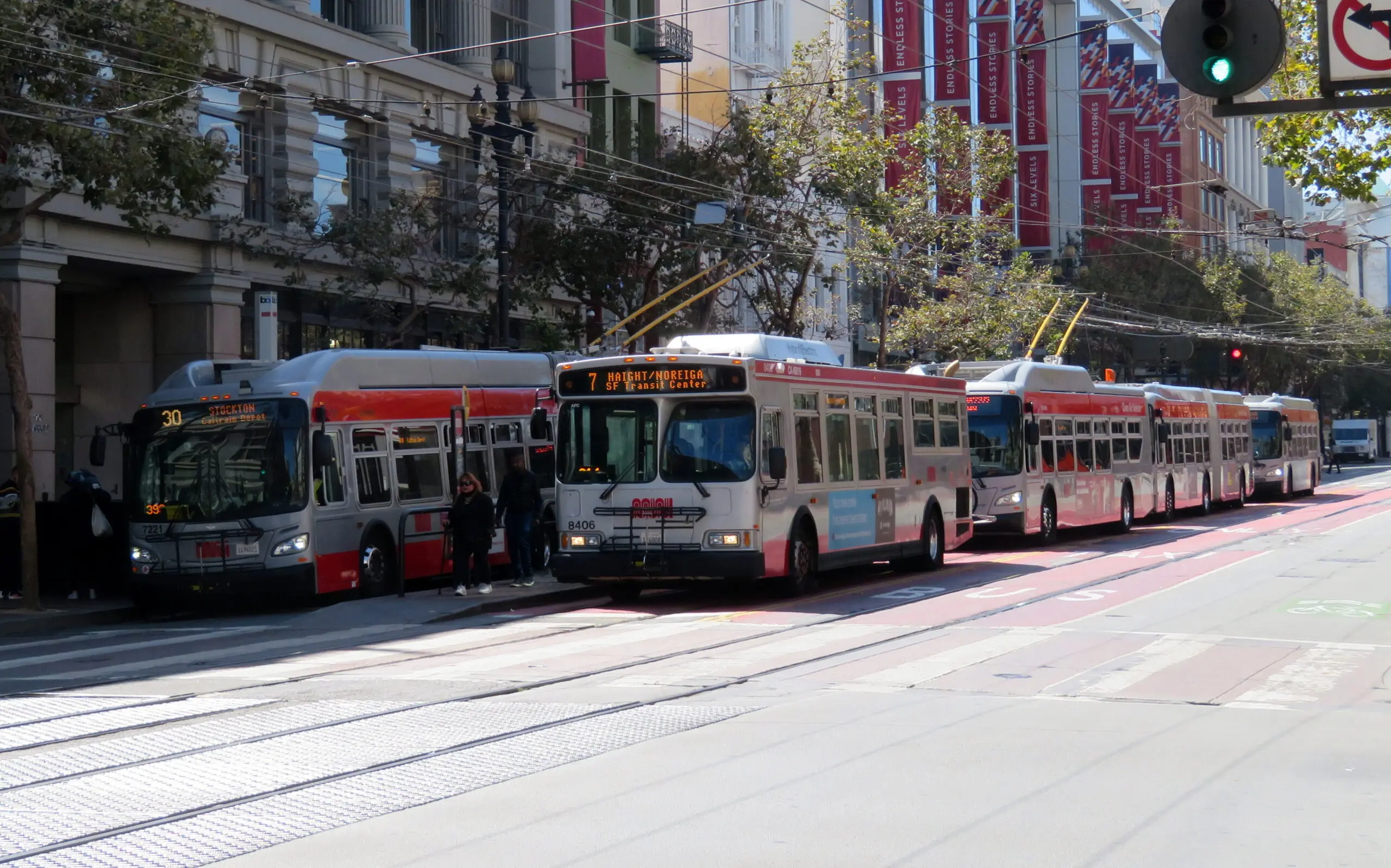
Why Muni Bus Signs Flash “Fare Required,” and What It Costs If You Don’t Pay
San Francisco, September 20, 2026. Since August, the front signs on Muni buses have been alternating between the usual line number and destination and a two-word message: “Fare Required.” The signs are part of a fare-compliance campaign the SFMTA calls Fares for Our Future, and the agency told KQED the message will keep running through late November. Here is what it means for anyone riding Muni this fall, including what the fine is, how to pay, and which payment option quietly disappeared on September 1.
What the sign is doing
The headsign is a changeable display, and SFMTA spokesperson Erica Kato told KQED it shows “Fare Required” for a few seconds before returning to the route and destination. Some riders have said the alternating display made it harder to tell which bus was pulling up at busy stops on Market Street, and a few buses have shown “Mask Required” instead, which KQED reports is a leftover setting from pandemic-era onboard computers rather than a current rule.
The message is scheduled to run until late November, shortly after the November 3 election, when San Francisco voters decide on a parcel tax to fund Muni.
The campaign behind it
Fares for Our Future was announced on May 5, 2026 at Harvey Milk Plaza by SFMTA leadership, Mayor Daniel Lurie, State Senator Scott Wiener and Supervisor Stephen Sherrill, according to the SFMTA’s own announcement. The agency says it consistently hears from riders who are frustrated at seeing other people not pay, and describes the plan as a package of 100-day and six-month actions.
Three pieces matter to riders. The SFMTA is hiring more transit fare inspectors; Hoodline, citing ABC7, put the number at 20 additional inspectors on top of a current force of 30 to 40. Riders without proof of payment can be fined $134. And about 6,000 SFMTA employees who used to show a staff badge as proof of payment are being issued Clipper cards so that they tap like everyone else.
The agency’s stated goal is compliance rather than penalty, and it is pairing enforcement with outreach on free and discounted fares for seniors, youth and low-income riders.
What counts as proof of payment
Muni runs on a proof-of-payment system. There is no turnstile on a bus or a surface streetcar; you tap or pay when you board, and an inspector can ask to see proof at any point in the trip. Per the SFMTA fares page, proof can be a paper ticket or pass, an activated ticket in the MuniMobile app, a plastic Clipper card, or a Clipper card in a phone wallet. Keep it until you get off.
Current fares and how to pay
The SFMTA fares page lists the adult single ride at $2.85 on Clipper, MuniMobile or a contactless credit or debit card, and $3.00 in cash or from a Metro station ticket machine. A single fare is good for 120 minutes of travel. Cash on board requires exact change. Youth 18 and under ride free on regular Muni service (not the cable cars), and seniors 65 and over and riders with disabilities pay $1.40 on Clipper.
Tap-to-pay with a chip credit or debit card is now available for adult single rides; you tap the same reader as a Clipper card. Note that the SFMTA fares page states that single ride passes are no longer sold in the MuniMobile app as of September 1, 2026, so if you rely on the app you will be buying a Day Pass ($5.70) or a longer pass instead, or switching to Clipper or a bank card for single trips. Our guide to the Muni payment changes has the full schedule of what leaves the app and when.
For visitors, the passes that cover cable cars are the 1-Day ($15), 3-Day ($35) and 7-Day ($47) Visitor Passports, available on MuniMobile, on Clipper or as a paper passport. A cable car single ride on its own is $9 with no transfers. Regular Muni Day Passes do not include cable cars.
What to do if you are stopped
Inspectors board buses and trains and ask each rider for proof of payment. If you paid with Clipper or a bank card, they scan the card; if you used MuniMobile, you show the activated ticket. The citation for no proof of payment is $134. Hoodline, citing a December 2024 SF Standard report, notes the SFMTA has waived the fine for most first-time offenders who enroll in the Lifeline or Clipper START income-based programs, but the current campaign pages do not promise that, so do not count on it.
The simplest approach for a visitor: load a Clipper card in your phone wallet before you arrive, or use a contactless credit card, tap once on boarding, and keep the phone or card handy. One tap covers 120 minutes of travel, including transfers between Muni lines.
For the rest of the month’s transit and street changes, see our Things to Do in San Francisco in September 2026 guide.
Photo: Pi.1415926535, CC BY-SA 3.0, via Wikimedia Commons.
More SF News
 India Basin’s 700 Innes Housing Site Faces Foreclosure After a Second Loan DefaultSep 20, 2026
 KEXP and Blue Bear Chosen to Remake the Haight and Ashbury Corner BuildingSep 19, 2026
 Mexican Navy Tall Ship Cuauhtemoc Opens to the Public at Piers 15-17 September 23Sep 19, 2026
 Yank Sing Closes Its Rincon Center Dim Sum Room September 20Sep 19, 2026