
San Francisco’s PG&E Grid Takeover: The Supervisors’ Vote Tuesday and the October 20 Price Deadline
The Board of Supervisors hears PG&E’s appeal on Tuesday, September 22, against the environmental review for San Francisco’s proposed purchase of the utility’s electric grid inside the city. It is one of two dates this fall that move the public power question forward: the second is October 20, when PG&E is due to tell the state regulator what it thinks its San Francisco poles, wires and substations are worth. Here is where the effort stands and what each step means.
What the city is trying to buy
San Francisco already generates and sells a lot of its own electricity. The San Francisco Public Utilities Commission says it supplies about 75 percent of the power used in the city, through Hetch Hetchy Power (which serves public facilities like the airport, libraries and Muni, plus a growing number of homes and businesses) and CleanPowerSF, the community choice program that buys clean power for most residents while PG&E delivers it over its lines. What the city does not own is the local distribution grid. The proposed acquisition would buy that grid from PG&E, so the SFPUC would deliver electricity as well as supply it, per the SFPUC.
If the purchase happened, the SFPUC would have to physically separate the San Francisco portion of PG&E’s system from the rest, generally along the San Francisco and San Mateo county line, so that two independently operated systems result.
Tuesday’s hearing: the environmental report
On July 9 the Planning Commission voted unanimously to certify the final Environmental Impact Report for the acquisition, a step required under the California Environmental Quality Act. The report covers the infrastructure changes and construction needed to separate the grid. PG&E appealed that certification to the Board of Supervisors, and the appeal is on the Board’s Tuesday agenda, according to The Voice of San Francisco.
PG&E’s position, as reported by The San Francisco Standard, is that the report is deficient and leaves out details the public should weigh, including years of construction with traffic, noise and air quality effects. The utility also disputes the city’s price estimate and argues a takeover would raise rates. The city’s position is that public ownership would improve reliability, advance clean energy goals and lower bills.
If the supervisors reject the appeal, the environmental review stands and the city clears one of the legal hurdles it would need before it could use eminent domain. The Standard reports that the city is not planning to go that route first; it is trying to buy the assets using revenue bonds.
October 20: what is the grid worth
The price is the open question. San Francisco filed expert testimony with the California Public Utilities Commission in April valuing PG&E’s San Francisco electric assets at about $3.4 billion. PG&E has not yet said what it thinks they are worth, and the CPUC has directed it to file that figure in October; the Standard gives the deadline as October 20. PG&E has called the city’s number unrealistic and says it does not account for the billions needed to separate the city from its grid.
The valuation proceeding at the CPUC was initiated by the city and runs separately from the environmental review.
How the city would pay
The SFPUC says the money would not come from the city budget or from taxes. It would come from revenue bonds repaid over time through electric rates, under Proposition A, which San Francisco voters approved in June 2018 with 77 percent support. That measure authorized the SFPUC to issue revenue bonds for clean power facilities with a two-thirds vote of the Board of Supervisors. Bond proceeds could only be used for the acquisition.
The SFPUC’s argument for lower bills is that a public utility pays no shareholder dividends, corporate taxes or executive bonuses and borrows at lower rates. It says its two existing programs saved customers more than $75 million in 2025 compared with PG&E rates. PG&E’s counter-argument is that the cost of separating and running the grid would push rates up. Both claims are the parties’ own.
Background
The current effort dates to former Mayor London Breed asking the SFPUC to study public power. San Francisco has been a public power provider for more than a century through Hetch Hetchy, and the SFPUC points out that more than 2,000 public power utilities operate in the United States, including Los Angeles, Sacramento, Palo Alto and Santa Clara in California. The Standard notes that supervisors’ views of PG&E hardened after the December blackout.
One more date: PG&E chief executive Patti Poppe and State Senator Scott Wiener, a public power supporter, are scheduled to speak at the Commonwealth Club on October 14.
Sources: SFPUC news release (July 9, 2026), The San Francisco Standard (September 20), The Voice of San Francisco (September 20).
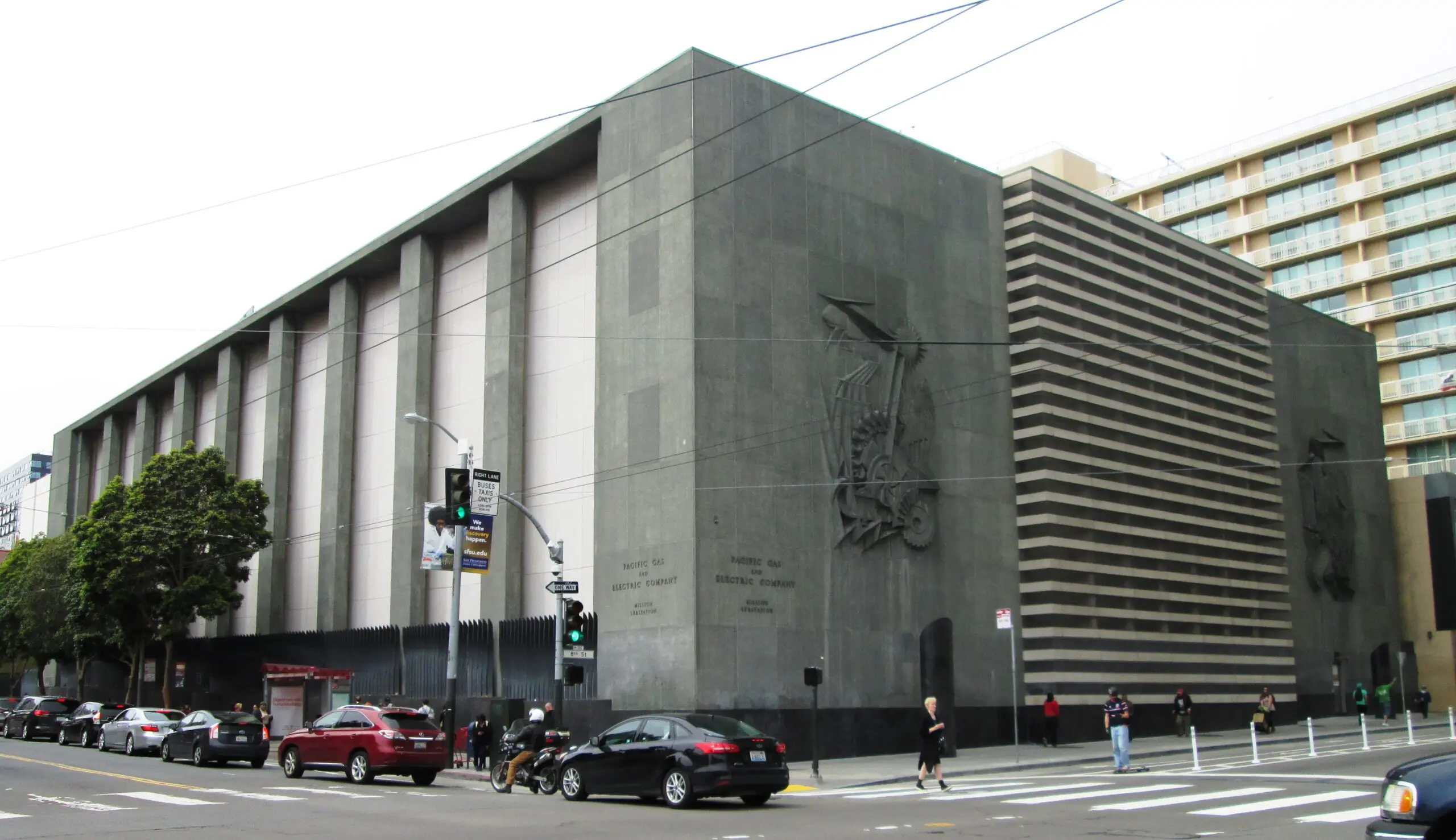
Photo: PG&E’s Mission Substation at 1200 Mission Street. Beyond My Ken, CC BY-SA 4.0, via Wikimedia Commons.
More SF News
 House of Air at Crissy Field Will Close February 15, 2027 as Its Presidio Lease EndsOct 18, 2026
 Embarcadero Park Pavilion: Three Designs Go to the Arts Commission October 19Oct 18, 2026
 San Francisco Speed Cameras Cut Excess Speeding 84 Percent in 18 Months, SFMTA Report SaysOct 17, 2026
 Westbound I-80 Closes Through SoMa October 23 to 26 for Bayshore Viaduct WorkOct 17, 2026