
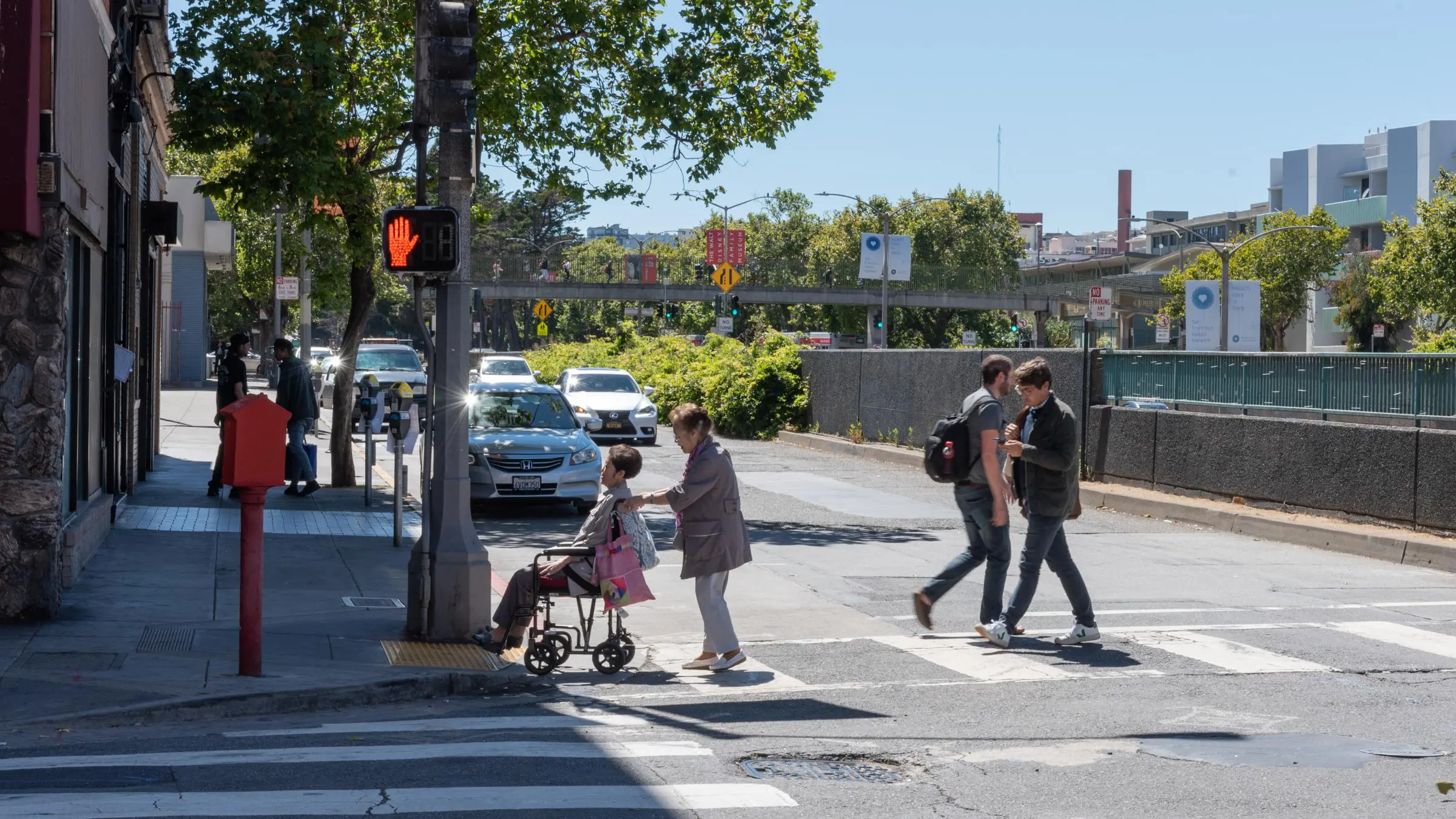
San Francisco Speed Cameras Cut Excess Speeding 84 Percent in 18 Months, SFMTA Report Says
San Francisco’s 33 speed safety cameras have cut the share of drivers going 10 mph or more over the limit at camera locations by about 84 percent, according to an 18-month report the SFMTA released on October 15, 2026. Before the cameras, 10 percent of drivers at those locations were going at least 10 mph over. By May 2026 it was 1.6 percent.
The agency says that works out to more than 42,000 fewer speeding instances per day across the camera sites. At the one-year mark, the SFMTA had reported a drop of about 79 percent, the figure behind the supervisors’ July request to lift the 33-camera cap.
What the Report Counts
The report covers the program from its March 2025 launch. Citations began in August 2025. Since then the cameras have produced 235,792 notices of violation and 226,077 warnings, with 588,124 warnings in total once the initial 60-day warning period is included.
Most drivers who got a ticket did not get another. The report says 62.9 percent of recipients received only one notice and 80.6 percent received two or fewer. Citations for driving 16 mph or more over the limit fell from over half of all notices at launch to under 3 percent.
By location, the report lists the steepest drops in 10-plus mph speeding on Monterey Boulevard (99 percent), Geneva Avenue (98 percent), Market Street (97 percent) and Alemany Boulevard (96 percent). The SFMTA’s summary also cites drops of more than half near Geary Boulevard and Fillmore Street and near Fulton Street and Arguello Boulevard. State law requires at least a 20 percent reduction at each site, and all 33 locations meet at least one of the state’s performance measures.
An independent evaluation by UC Berkeley’s Safe Transportation Research and Education Center (SafeTREC) found excess speeding stayed well below baseline 40 to 50 weeks after the cameras switched on. Speeding also fell at comparison sites with no cameras, which SafeTREC says may point to a citywide shift. The report does not yet include crash results; the SFMTA says it will analyze collision data as it becomes available.
Money In, Money Out
First-year revenue, from August 2025 to July 2026, was $6.5 million. Initial program costs from November 2023 to June 2026 came to about $4.3 million, including a vendor contract of $1.5 million a year. The SFMTA says about $2.2 million has gone back into traffic calming, and it plans to spend first-year revenue on speed humps on residential streets and rectangular rapid flashing beacons.
Where the Cameras Are and What a Ticket Costs
The SFMTA’s speed safety camera page lists all 33 locations. Several are on streets visitors drive: The Embarcadero between Green and Battery streets, Columbus Avenue between Lombard and Greenwich streets, Broadway between Powell and Stockton streets, Bay Street between Octavia and Gough streets, Fulton Street between 2nd Avenue and Arguello Boulevard, Lincoln Way between 27th and 28th avenues, and Sloat Boulevard between 41st Avenue and Skyline Boulevard.
Cameras only cite drivers going 11 mph or more over the limit, and tickets are mailed to the registered owner. Fines are set by state law (AB 645): $50 for 11 to 15 mph over, $100 for 16 to 25 mph over, $200 for 26 mph or more over, and $500 for 100 mph or more. Drivers with low incomes pay half, and people enrolled in programs such as CalFresh, CalWORKs and Medi-Cal pay 20 percent of the standard fine.
What Comes Next
The cap stays at 33 for now. The report says the SFMTA will work with the other pilot cities (Oakland, San Jose, Los Angeles, Long Beach and Glendale) to push for more locations and an extension of the five-year pilot. It will also review each site for possible relocation, keep publishing quarterly data on the city’s open data portal, and run a regional public information campaign with Oakland and San Jose.
The cameras sit alongside other speed changes in the city, including lower speed limits near 230 schools, and the SFMTA’s count of 100 fatal or severe crashes in the first half of 2026.
Photo: SFMTA.
More SF News
 Westbound I-80 Closes Through SoMa October 23 to 26 for Bayshore Viaduct WorkOct 17, 2026
 Highway 37 Closes Both Ways Between Vallejo and Sears Point October 23 to 26 for El Niño WorkOct 16, 2026
 Mid-Market Gets $500,000 for a Theater District Pilot on the 900 Block of Market StreetOct 16, 2026
 Nordstrom Rack Will Open at 2 Stockton St. Near Union Square in Fall 2027Oct 16, 2026